Verified > 99% Lab-grade Peptides
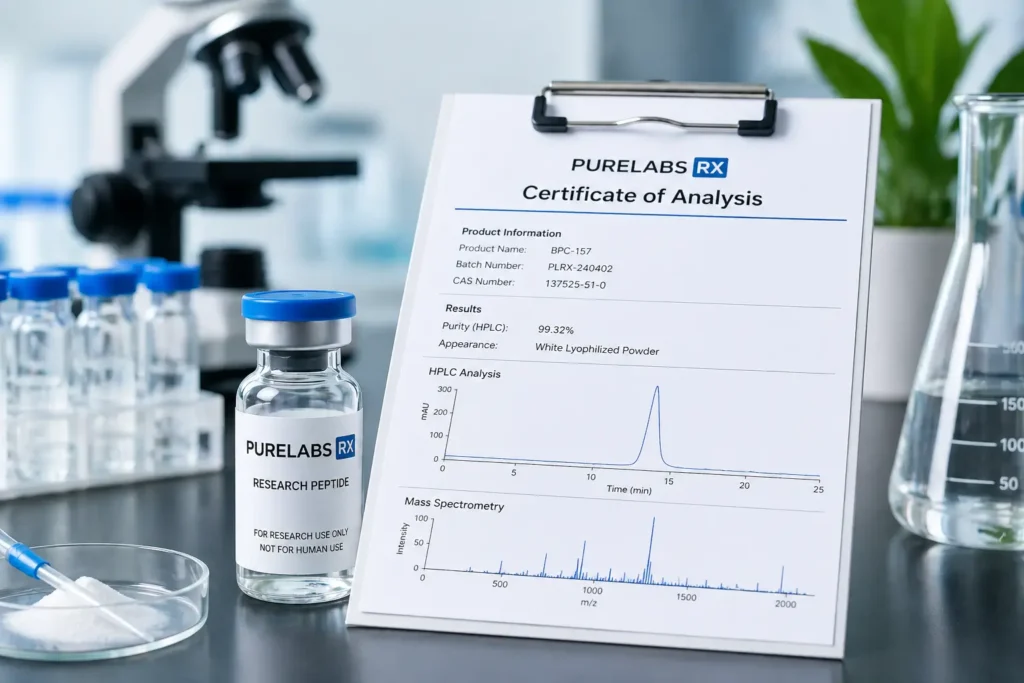
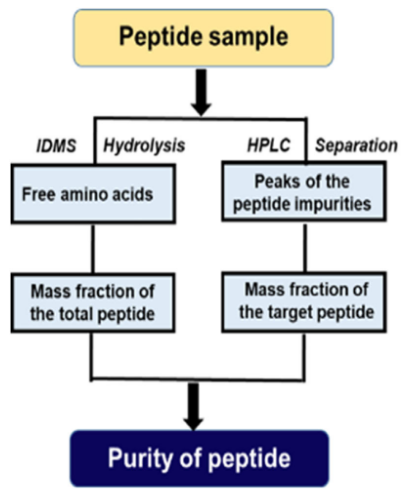
Peptide Check over here Screening: Hplc & Mass Spec Purity Overview Apex Desalted peptides function well for ELISA covering, some cell-based assays, and applications where moderate purity serves. After synthesis and filtration, peptides are commonly lyophilized (freeze-dried) as salts. The most usual counterion is trifluoroacetate (TFA) from the HPLC filtration solvents, though some peptides are provided as acetate or hydrochloride salts. These counterions aren't "contaminations" in the HPLC feeling-- they don't appear as different optimals-- but they do contribute to the complete mass of the powder. As the percentage of natural solvent gradually increases throughout the run, molecules are launched from the column in order of their hydrophobicity-- the a lot more hydrophobic a peptide, the longer it takes to elute (clean off). Because pollutants usually differ from the target peptide by at least one amino acid, they have somewhat different hydrophobicities and show up as separate optimals on the chromatogram. The ratio of primary peak to total optimals determines the reported purity portion. Be cautious of COAs that supply a purity number without any sustaining chromatographic information, report purity without specifying the logical approach, or listing a molecular weight without mass spectrometry verification. This matters because peptides are constructed one amino acid each time with solid-phase peptide synthesis (SPPS). At each action, there's a tiny chance that something fails-- an amino acid does not attach, the wrong modification takes place, or a side reaction generates an unplanned byproduct. Over a chain of 10, 20, or 40 amino acids, those little per-step mistake rates substance. If each and every single action went to 100% completion, after that only the full-length peptide would be generated. We use dialysis, ultrafiltration integrated with HPLC/UV approaches to medically evaluate encapsulation performance and medication loading. First, a small quantity of the peptide is liquified in a liquid and injected into the HPLC maker. That fluid is then pressed via a slim tube (called a column) under high pressure. Inside the column are tiny particles that briefly "grab onto" different materials in the sample.
Nanoparticle Physicochemical Home Analysis
Where can I send my peptides to test for purity?
ACS Peptide Evaluating Labs is an expert peptide evaluation lab that approves examples from all 50 states. Whether you need to test peptide purity, verify a supplier''s Certificate of Evaluation, or run thorough pollutant screening, our laboratory gives fast, accurate outcomes with detailed coverage.
The Requirement For Enhanced Understanding Of Logical Ultracentrifugation Contour Fitting
Peptide Examination is a US-based lab offering HPLC and UV analysis for peptide verification. The lab emphasizes effective sample processing and accuracy in peptide evaluation. The vendor rating system accumulations examining results, enabling scientists to compare high quality fads throughout various vendors.- The launch process of peptide formulas is intricate, and an absence of scientific information impedes growth.
- A couple of sell totally inert materials, capitalizing on the problem of discovery without correct screening.
- As the research study peptide market continues to grow, recognizing how peptide purity screening works can aid researchers make more enlightened sourcing choices and far better assess supplier transparency.
- This is why peptides are generally used at different pureness grades.